
Constructing Data Centers that Power Artificial Intelligence (AI) Learn More
Office Reoccupancy and Commercial Space Transitions in San Francisco
Tenant Improvement, Relocation, Decommissioning, and Commissioning
As San Francisco’s office market begins to stabilize and office visits increase, commercial tenants are reactivating office space to support an increase in in-person occupancy. This shift is driving demand for infrastructure upgrades, system reconfiguration, and coordinated space transitions that ensure buildings can operate reliably under higher load and daily use.
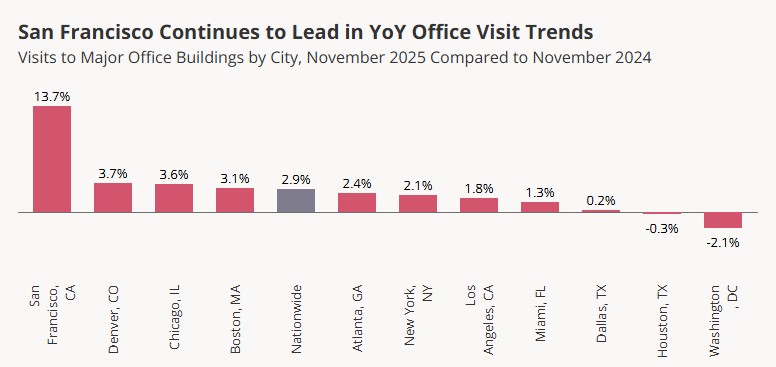
Recent data shows San Francisco leading major U.S. cities in year-over-year office visit growth.
Tenant improvement, relocation, decommissioning, and commissioning represent interconnected phases of a single transition process. When executed together, they reduce risk, compress schedules, and support operational continuity.
Tenant Improvement Driven by Operational Requirements
Current tenant improvement projects are focused on system performance rather than aesthetics. Reoccupied offices must support increased power demand, higher network utilization, expanded AV capabilities, and secure access control across denser floor plans.
Legacy infrastructure often reflects pre-pandemic assumptions around occupancy and usage. As headcount returns, capacity limitations in electrical distribution, structured cabling, and system integration become critical path issues. Tenant improvement scopes now routinely address these constraints to ensure long-term functionality.
Relocation Planning and System Continuity
Relocation projects require early coordination across electrical, low-voltage, IT, and facilities teams. Critical systems must be sequenced for shutdown, removal, preservation, or redeployment without disrupting active business operations.
Network rooms, backbone fiber, security systems, and AV infrastructure require detailed documentation prior to de-installation. When relocation is treated as an infrastructure transition rather than a logistical exercise, schedule risk and unplanned downtime are significantly reduced.
Decommissioning of Complex Office Infrastructure
Decommissioning modern office environments involves the systematic removal of layered systems, including IT rooms, structured cabling, access control, fire protection, dedicated HVAC units, and rooftop or exterior equipment.
BEI approaches decommissioning as a controlled technical process. Existing conditions are surveyed and documented, live systems are identified, and removals are coordinated with building management and riser authorities. Equipment is categorized for reuse, relocation, recycling, or certified e-waste processing, ensuring compliance with safety, environmental, and operational requirements.
Commissioning and System Validation
Following installation and reconfiguration, commissioning validates that electrical and low-voltage systems perform as designed. Power, network, AV, security, and life safety systems are tested in integrated conditions to confirm readiness prior to occupancy.
Effective commissioning reduces post-move corrective work and supports a smoother operational handoff to facilities and IT teams.
BEI’s Role in Commercial Space Transitions
BEI provides electrical and low-voltage services for tenant improvement, relocation, decommissioning, and commissioning projects in active commercial environments, with a focus on system coordination, safety, and schedule control.
In a recent Bay Area office transition, BEI supported the decommissioning and restoration of a multi-floor commercial space as part of a relocation effort. The scope included project management and coordination with facilities and IT teams to document existing conditions and safely remove infrastructure.
Work included electrical and low-voltage decommissioning, structured cabling and backbone fiber removal, IT room equipment de-installation, and removal of AV, security, and access control systems. Dedicated HVAC units, fire protection infrastructure, and rooftop equipment were removed in coordination with building management and riser authorities.
Removed materials were evaluated through BEI’s Green Team Sustainability Program for reuse, recycling, certified e-waste processing, or disposal. The project was completed within a defined schedule to support timely space close-out.
BEI’s experience managing complex infrastructure transitions enables clients to reactivate office space efficiently, safely, and with confidence.